Search This Blog

Friday, March 13, 2015

Birthing Demons

The Sooterkin is a "a fabled small creature about the size of a mouse that certain women were believed to have been capable of giving birth to." (Wikipedia)

Thursday, March 5, 2015

WUT


From https://nyamcenterforhistory.files.wordpress.com/2014/08/cat-mouse.jpg?w=300&h=287

Because my research makes for unforeseen search results


from HERE

Thursday, February 26, 2015

Wednesday, February 25, 2015

Tuesday, February 24, 2015

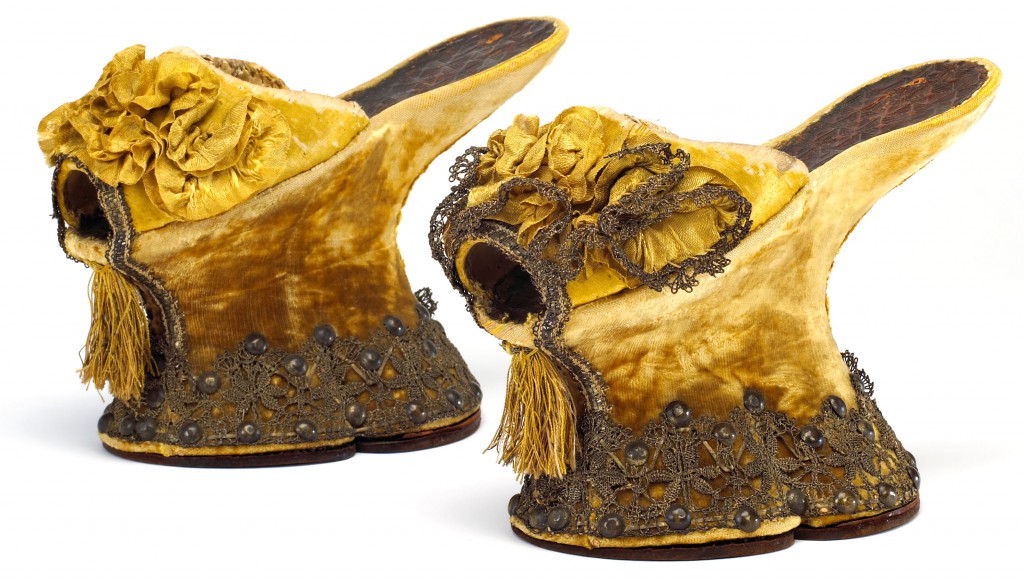
High Heels for Wartime Domination

"When the soldier stood up in his stirrups, the heel helped him to secure his stance so that he could shoot his bow and arrow more effectively."

In the muddy, rutted streets of 17th Century Europe, these new shoes had no utility value whatsoever - but that was the point. "One of the best ways that status can be conveyed is through impracticality."


- Elizabeth Semmelhack of the Bata Shoe Museum in Toronto quoted in this article.


Nautilus

A wonderful collection of weird and wonderful largely medical objects:

http://www.thenautilus.it/


Moulage of a child with dyptheria

Mechanical owl hunting decoy

Perfume dispenser


How to Become a Byzantine Princess

Justinian and Theodora are the Posh&Becks of the Byzantine Empire. But not many people know how Theodora--a low-born lady--caught Justinian's eye. Well, it involved a little party trick she does with her lady parts:

"Often, even in the theater, in the sight of all the people, she removed her costume and stood nude in their midst, except for a girdle about the groin: not that she was abashed at revealing that, too, to the audience, but because there was a law against appearing altogether naked on the stage, without at least this much of a fig-leaf. Covered thus with a ribbon, she would sink down to the stage floor and recline on her back. Slaves to whom the duty was entrusted would then scatter grains of barley from above into the calyx of this passion flower, whence geese, trained for the purpose, would next pick the grains one by one with their bills and eat. When she rose, it was not with a blush, but she seemed rather to glory in the performance. For she was not only impudent herself, but endeavored to make everybody else as audacious. Often when she was alone with other actors, she would undress in their midst and arch her back provocatively, advertising like a peacock both to those who had experience of her and to those who had not yet had that privilege her trained suppleness."

From The Secret History of Procopius, trans Richard Atwater, 1927, p. 102-103

Leda and the Swan by Francois Boucher

Wednesday, February 18, 2015

Tuesday, February 10, 2015

Sexy Northern Mannerism

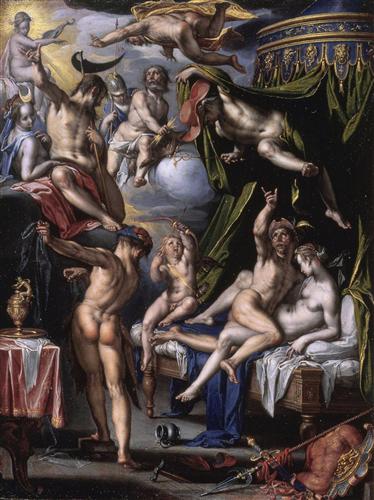
Impossible bodies by Hendrick Goltzius and his student Joachim Wtewael [Oot-vayl]:

Mars and Venus Surprised by Vulcan, Getty Museum, c. 1601-1610

Mars and Venus Surprised by Vulcan, Mauritshuis, 1601

I have seen both of these in person and there are much smaller than you would expect. They are also incredibly vibrant because rather than painting on wood, he painted on copper, which better preserves the original color. 

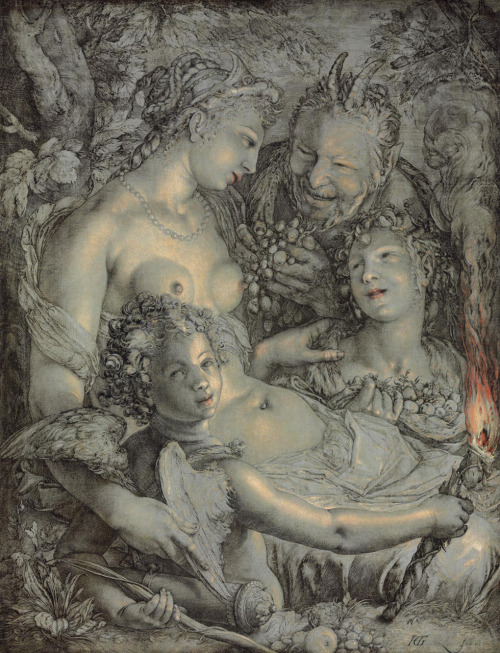
Goltzius, Without Bacchus and Ceres, Venus Would Freeze (Sine Cerere et Libero friget Venus), c. 1600-1603

Also something that should be seen in person. Goltzius is known for having done engravings (e.g. below). Here, is is experimenting with pen and oil paint, creating the sinuous lines as if they were made by engraving. The oil is used to add color and highlights, washing most of the painting in blue to give it the feeling of freezing and allowing the warm glow of the fire to stand out. Venus's protruding nipples are echoed by her pearl necklace and she wakes up, giving and receiving various caresses--as the grapes touch her nipple, she strokes Cupid's wing and lightly touches Ceres's shoulder. 

Here are some details to show the cross-hatching:


More prints by Goltzius:


Saturday, February 7, 2015

Friday, February 6, 2015


Josef Mattersberger (1754-1825), influenced by Dürer

Tuesday, January 27, 2015

A Creepy Wikipedia Primer on Gilles de Rais

In his confession, Gilles maintained the first assaults on children occurred between spring 1432 and spring 1433.[27] The first murders occurred at ChamptocƩ-sur-Loire; however, no account of these murders survived.[28] Shortly after, Gilles moved to Machecoul where, as the record of his confession states, he killed, or ordered to be killed, a great but uncertain number of children after he sodomized them.[28] Forty bodies were discovered in Machecoul in 1437.[28]
The first documented case of child-snatching and murder concerns a boy of twelve called Jeudon (first name unknown), an apprentice to the furrier Guillaume Hilairet.[29] Gilles de Rais' cousins, Gilles de SillƩ and Roger de Briqueville, asked the furrier to lend them the boy to take a message to Machecoul, and, when Jeudon did not return, the two noblemen told the inquiring furrier that they were ignorant of the boy's whereabouts and suggested he had been carried off by thieves at Tiffauges to be made into a page.[29] In Gilles de Rais' trial, the events were testified to by Hillairet and his wife, the boy's father Jean Jeudon, and five others from Machecoul.
In his 1971 biography of Gilles de Rais, Jean Benedetti tells how the children who fell into Rais's hands were put to death:
[The boy] was pampered and dressed in better clothes than he had ever known. The evening began with a large meal and heavy drinking, particularly hippocras, which acted as a stimulant. The boy was then taken to an upper room to which only Gilles and his immediate circle were admitted. There he was confronted with the true nature of his situation. The shock thus produced on the boy was an initial source of pleasure for Gilles.[29]
Gilles' bodyservant Ɖtienne Corrillaut, known as Poitou, was an accomplice in many of the crimes and testified that his master hung his victims with ropes from a hook to prevent the child from crying out, then masturbated upon the child's belly or thighs. Taking the victim down, Rais comforted the child and assured him he only wanted to play with him. Gilles then either killed the child himself or had the child killed by his cousin Gilles de SillĆ©, Poitou or another bodyservant called Henriet.[30] The victims were killed by decapitation, cutting of their throats, dismemberment, or breaking of their necks with a stick. A short, thick, double-edged sword called a braquemard was kept at hand for the murders.[30] Poitou further testified that Rais sometimes abused the victims (whether boys or girls) before wounding them and at other times after the victim had been slashed in the throat or decapitated. According to Poitou, Rais disdained the victim's sexual organs, and took "infinitely more pleasure in debauching himself in this manner ... than in using their natural orifice, in the normal manner."[30]

In his own confession, Gilles testified that “when the said children were dead, he kissed them and those who had the most handsome limbs and heads he held up to admire them, and had their bodies cruelly cut open and took delight at the sight of their inner organs; and very often when the children were dying he sat on their stomachs and took pleasure in seeing them die and laughed”.[31]

Monday, January 19, 2015

Medical Poetry

THIS ARTICLE FROM THE NEW YORKER explores new medical poetry. It isn't rare--which is exactly why the Hippocrates Initiative and the Institute for Poetic Medicine exist. And there's always William Carlos Williams.

Wednesday, January 14, 2015

Sunday, January 11, 2015

Bone Records


All you need to know HERE

Friday, January 9, 2015

Cervical Mimesis

In his Isagogue Breves of 1522, Jacopo Berengario da Carpi describes the cervix as such:

"Between the cervix [here meaning the uterine neck] and inner receptacle is a certain substance of pelicular flesh which is quite sensitive, perforated in the middle, capable of dilation and constriction, called the mouth of the uterus and having the form of...
a newborn kitten"*


*Jacopo Berengario, A Short Introduction to Anatomy (Isagogue Breves), trans. L. R. Lind (Chicago: University of Chicago Press, 1959), 78.

Thursday, January 8, 2015

Your Own Personal Miniature Punching Bag

Here's a story on the mystery of the uvula


The Art of Vaccine

From The New York Times


“After learning that the Chinese characters for smallpox mean ‘heavenly flowers’ — because the pustules bloom on the body, and the sufferers eventually die — Ms. Sinclair, who makes historically-inspired tableaus, created a scene of an 18th-century doctor administering a vaccination, surrounded by grass and blossoms.”

Another Thing You Never Wanted to know

PUPPY WATER


D:

Monday, December 22, 2014

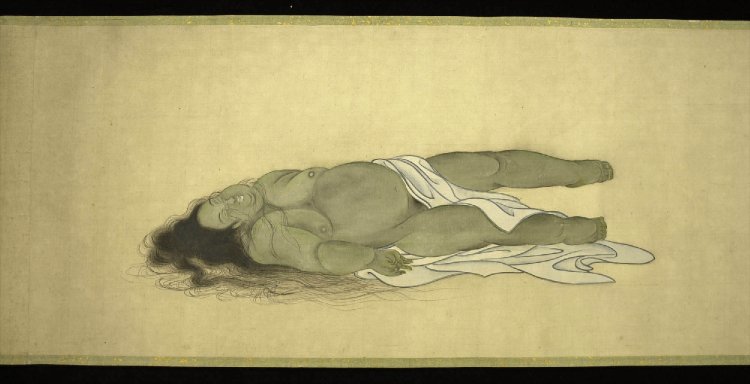
Courtesan in Nine Stages of Decomposition


By Kobayashi Eitaku, ink and pigment on silk, c. 1870

More HERE

Sunday, December 14, 2014

Artwork of Sarah Suppan

From her website HERE and a post by Street Anatomy HERE


Saturday, December 13, 2014

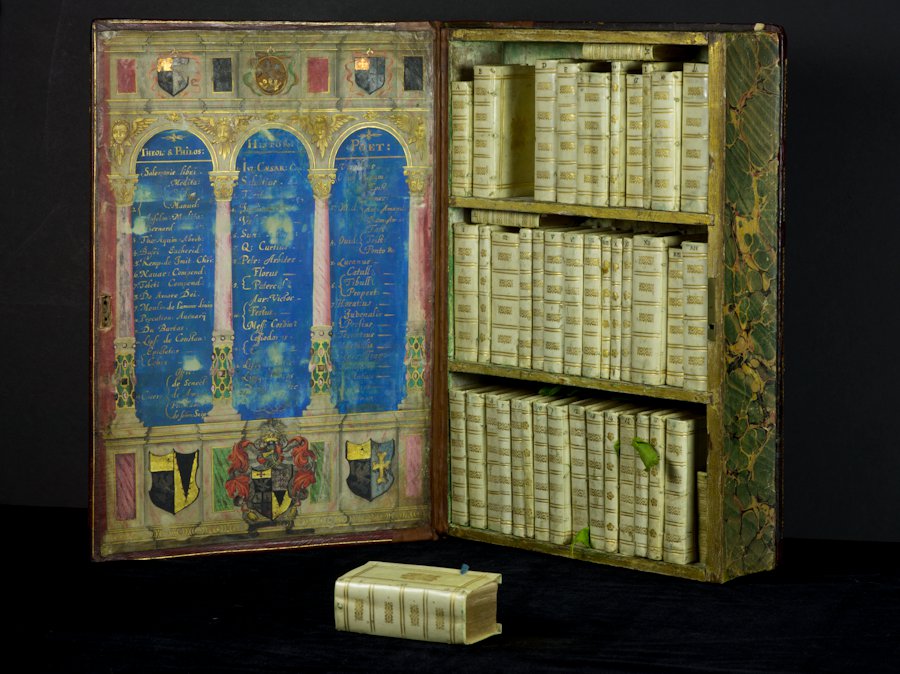
Traveling Library (i.e. Jacobean Kindle)


More pictures HERE!

On the Flu

From the NY Times Flu Quiz:

The term influenza was first applied to the disease because early Europeans believed that the widespread nature of flu epidemics were caused by the movement of the planets, moon and stars. The word was adopted into English in 1743.

Doctors in 1918 tried various methods to cure patients of the flu. These included prescribing whiskey or cigars, asking them to gargle salt water, dousing patients with ice water or bleeding them. Some tried a surgical procedure to extract pus and blood from the chest cavity, however this procedure was almost always fatal.


Source: Iezzoni, Lynette. 1999. Influenza 1918: The Worst Epidemic in American History. New York, NY: TV Books, L.L.C.


Spinning a 17th-Century Globe

HERE!


Thursday, December 11, 2014

Anatomy in Germany


From the Fembo Haus


From a book in the City Archives


From the Germanisches Nationalmuseum