Search This Blog

Showing posts with label flora. Show all posts

Sunday, May 31, 2015

Xylotheks

According to Atlas Obscura:


A xylothek (from the Greek for tree, xylon, and storing place, theke) is an object where the container is a fundamental component of the contents. The term usually refers to books that are both made of wood and filled with wood specimens…. Xylotheks were particularly popular in late 18th century and early 19th century Germany. In these constructions, each book in the xylothek was made out of a particular type of wood, the spine covered with the corresponding bark and decorated with associated moss and lichens. Once opened, the book would reveal samples of dried leaves, flowers, seedlings, roots, and branches, with a special compartment in the spine holding a written description of the species' biology and use.

Sunday, August 31, 2014

Corny

Because I had to share this from the Public Domain Review:


Sunday, August 10, 2014

Saturday, December 29, 2012

Wednesday, March 28, 2012

Van Gogh, Up Close-ish

Funniest thing about the exhibition Van Gogh Up Close at the PMA is that a whole section of paintings from a private collection had to have spacers to keep the audience a certain distance away.

There were also a couple of cheap side-galleries with relatively weak excuses for their existence, i.e. Van Gogh hated photography, so let's show you what he probably hated. The one on Japanese influences and Hiroshige was awesome, and also taken almost directly from the Van Gogh Museum's section on it. But it's worth seeing stuff like this:
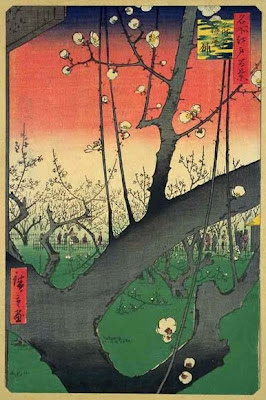

Ando Hiroshige, Kameido Ume (Japanese apricot) Garden, 1857

See here for Van Gogh's version.

Nonetheless, lots of other good stuff going on with the paintings themselves:
Cut Sunflowers, 1887, Metropolitan Museum of Art, New York City

It's difficult to find some of the works from the show, since they didn't show many of his most famous works but had a whole slew of studies of underbrush and grasses--the grasses actually being my favorite and reminding me of Leonardo's study of hair, but with a greater sense of how he uses color and texture in light of visual movement.


Almond Blossom, 1890, Van Gogh Museum, Amsterdam

This is the final piece of the show, showing an immense sense of control--it fully displays his chosen style, but also shows an amazing amount of restraint in the coloring of the background in contrast to his much more motley scenes in the rest of the show.

Unfortunately, it is impossible to get a sense of the color of this painting without seeing it in person. Going through the gift shop afterwards made this painfully obvious. A google search is even worse: Ouch. +1 points for Wikimedia, who did the best job by far.

Oh, and just to add some Van Goghnatomy:


Friday, March 2, 2012

Tulips


A prized tulip, the Semper Augustus. It was a rare and expensive find in the 1600s, and even moreso now since its variegation is due to a specific virus. See this link.

Thursday, February 23, 2012

Byssus, Sea Wool, Mermaid Silk

Never heard of it? Me neither, until now. It is the "beard" of a mussel--fibers that anchor it to a spot--but that were used for luxury textiles in the middle ages. When dried, it apparently looks like Donald Trump's hair:


Wednesday, February 8, 2012

Darwin v. Ruskin: On Beauty, Orchids, and Peacock Feathers, part 1


In his Descent of Man, Darwin put forth his theories on sexual selection. Much of it dealt with attractiveness to possible mates, and the choice of the females of different species to mate or not to mate. But in his volume on orchids, On the Various Contrivances by which British and Foreign Orchids are Fertilised by Insects (1862), he went further into exploring how the actual forms of species could adapt specifically for the purpose of the survival of their genetic line. John Ruskin, as an eminent art historian, disagreed, asserting that beauty could not have such base origins. Not that it was aesthetics in its modern sense that they were dealing with--it is looks. The look of things, as we all should know, affects its reception. And "lookism," a term coined at least once, by the New York Times, has deep roots in history. I am specifically concerned with form in flora and fauna and the facial characteristics of human beings, since physiognomy became a huge prospective science of the 19th-century, along with craniometry (it's similarly retrospectivally racist cousin).