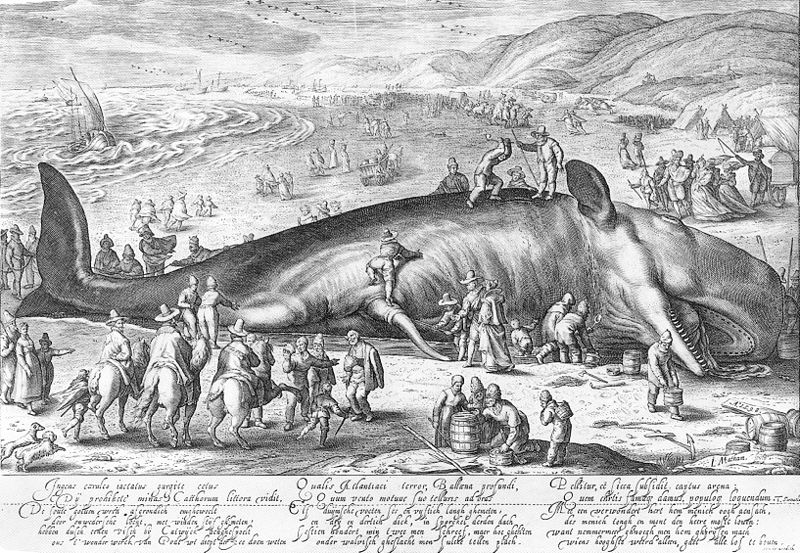
“A large whale, thrown up out of the blue sea (gods, let it not be a bad omen!), washed up on the beach near Katwijk. What a terror of the deep Ocean is a whale, when it is driven by the wind and its own power on to the shore of the land and lies captive on the dry sand. We commit this creature to paper and we make it famous, so that the people can talk it about it.”
They were always considered omens, in this case one that coincided with a Spanish attack on the Netherlands.
I also came across this print, from a wildly different context:
Recently Slate had a story on how the great Blue Whale was suspended from the ceiling of the Natural History Museum in New York.
A second famous whale in the museum is shown fighting with a giant squid for its life. If you haven't seen either in person, the movie The Squid and the Whale does a good job of conveying the nostalgic feeling many have for them.
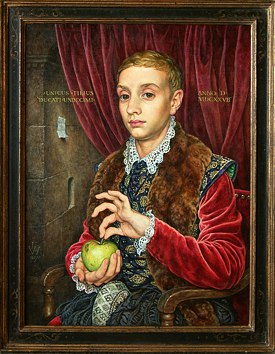
Firstly, Boy with Apple may now be my favorite forgery of all time (with the forgery of the Northern Renaissance style triptych at the Palmer Museum of Art). This is partially everyone was meant to know it was fake--it was made for a movie--but also because it is convincing in its details. The Guardian delicately threw a few examples out there in their article Is The Grand Budapest Hotel's 'Boy with Apple' artwork plausible? See The Gallerist on this as well.
But the movie was a graphic design whirlpool of Eastern European pre-war imagery. The Creative Review looks at many of the painstakingly rendered props in Designing for The Grand Budapest Hotel. And they look at more images of little details like keychains, perfume, etc. at The Warholian.
For those who don't know, the Smashing Pumpkin's Tonight, Tonight video was based largely on the work of the early filmmaker Georges Méliès, after whom the ship carrying the music video's protagonists is named. Méliès' Voyage dans la Lune was the main inspiration:
La Sirène was another film that likely gave shape to the undersea scene
Méliès was made a fictional character in the recent book and movie Hugo. It also stars an automaton!
Super creepy mandrake root from the movie Pan's Labyrinth that TALKS.
"Since the Mandrake root looked human, it was said that it was alive and to take it from the earth was to tear it from its home. It would, therefore, give a terrible scream when pulled up. That scream was so terrible that it would drive insane the person who had tried to take it, or even kill with its shriek. There was, then, a special way in which one obtained a Mandrake. Needed were a hunting horn, a length of rope, a hungry dog, and a piece of meat. The Mandrake was said to grow beneath a gibber, feeding on the fat dripping from the hanged corpse. On the night of a full moon, the magician had to drop a noose of the rope over the Mandrake and then tie the other end to the dog's collar. He would then retire to a safe distance and throw down the piece of meat. The dog, being hungry, would lunge forward to get the meat, pulling on the rope and dragging the mandrake out of the soil. At that point the magician should blow loudly on the horn to drown out the sound of the plant's scream. The dog would hear the scream and drop dead, but the magician would have his mandrake!" -from The Mysterious Human-Shaped Mandrake Root
I study art history and I tend to find curious things that incite questions, reveal our corporeal unease, and generally make us think about how we consider the human body conceptually and physically. And so I present to you the strange gems I've come across.