Search This Blog

Showing posts with label giant dead fish. Show all posts

Wednesday, April 30, 2014

Whales, out of their natural context

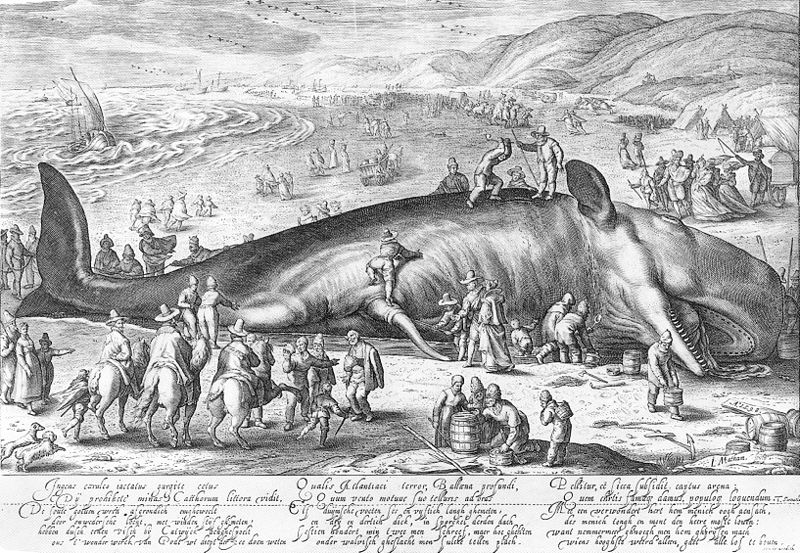
In light of the recent beached whale set to explode, memories of the 1970 planned explosion of a beached whale that, somewhat comically but also tragically, didn't work out so well, and the extra-gross whale that exploded when it was being cut open, I started thinking about other beached whales I had come across in prints and texts.

Jan Saenredam, Stranded Whale, 1602

One website provides the translation of the text:

“A large whale, thrown up out of the blue sea (gods, let it not be a bad omen!), washed up on the beach near Katwijk.  What a terror of the deep Ocean is a whale, when it is driven by the wind and its own power on to the shore of the land and lies captive on the dry sand.  We commit this creature to paper and we make it famous, so that the people can talk it about it.”

They were always considered omens, in this case one that coincided with a Spanish attack on the Netherlands.

I also came across this print, from a wildly different context:

Ida Bagus Nyoman Rai-Sanur, Indonesia, 1970s


Recently Slate had a story on how the great Blue Whale was suspended from the ceiling of the Natural History Museum in New York.


A second famous whale in the museum is shown fighting with a giant squid for its life. If you haven't seen either in person, the movie The Squid and the Whale does a good job of conveying the nostalgic feeling many have for them.


Saturday, March 10, 2012

Damien Hirst and Dead Stuff

Quotes from a Guardian article on his mid-career retrospective:

As a teenager, he made regular visits to Leeds University's Anatomy Museum to practise drawing, and it was there he found inspiration for his first piece of shock art: a photograph mounted on a steel frame called With Dead Head, first exhibited in 1991, in which his 16-year-old self poses, grinning, beside the severed head of a middle-aged man which sits on a mortuary table. It set the scene, if not the tone, for much of what was to follow.


Having been bought by Saatchi for £50,000, the shark in the formaldehyde-filled vitrine became an icon of contemporary art of the 1990s and perhaps the defining work of what would come to be known as the YBA movement...In 2006, the original shark, having deteriorated, was replaced at Hirst's insistence by a new formaldehyde-injected one, which was then loaned to the Metropolitan Museum of Art in New York. It is that shark that visitors to the Tate Modern show will see. (Both Hirst and Cohen seem unfazed by the big art-historical question of whether a replacement can ever have the import of the original art work. Only time will answer that one.)

"It's what Jeff Koons once referred to as a high-maintenance piece of art," says Hirst, when I ask him about the practicalities of owning a shark in a tank. "The formaldehyde works are guaranteed for 200 years. I would like it to always look as fresh as the day I made it, so part of the contract is: if the glass breaks, we mend it; if the tank gets dirty, we clean it; if the shark rots, we find you a new shark." At 22 tons, it must be a bugger to transport, though? "Not really. The tank and the shark travel separately. Then you clean it and set it up, add the formaldehyde. Basically," he says, without irony, "it's just a big aquarium with a dead fish in it."


Hymn, 1996