Search This Blog

Tuesday, June 26, 2012

via Morbid Anatomy

The works of Saul Chernick


Largely based on the works of Hans Baldung Grien:


Thursday, May 31, 2012

Tuesday, May 29, 2012

Evolution before Darwin

Most people today are taught only the basics about the history of evolution, which ends up with us all thinking evolution=Darwin. But these ideas were floating around long before Darwin. I will give just a few examples.

In terms of how the design of living things are due to their function, look no further than Luther--not saying he's correct in his statement, but the idea is there:

“Men have broad shoulders and narrow hips, and accordingly they possess intelligence. Women have narrow shoulders and broad hips. Women ought to stay at home; the way they were created indicates this, for they have broad hips and a wide fundament to sit upon.” [No. 54]"


Lucas Cranach, Martin Luther and Katarina von Bora
(note her tiny waist--a visual trope throughout Cranach's portraits of women that seems to echo Luther's statement)

But also when it comes to climate, it was known in ancient times that environment could affect general physiological or anatomical differences, an explanation for the Eastern folks with deformed heads or the bandy-legged Ethiopians described by Hippocrates.


Closer to his own time, folks like Lamarck were putting forth evolutionary theories. And his most closely resemble what we know think of as "social Darwinism"--a phenomenon that is an extrapolation from Darwinism used to justify social inequality by creating arguments that it is part of a natural hierarchy. 

Damien Hirst's Anatomy of an Angel


Wednesday, May 16, 2012

Bellmeriana


Hans Bellmer. La Poupée (The Doll), detail. Paris, Editions GLM, 1936. Linocut on pink paper; 16.7 x 12.8 cm.


Monday, May 14, 2012

The Many Uses of Feminine Products

1. Douse tampons with hydrogen peroxide or bleach to spot-clean clothing stains
2. Use maxi pads to absorb spills on the carpet
3. Allow children to use maxis as stickers--they will stick on anything and come off clean!
4. Collages
5. Use tampons as makeshift "growing sponge" toys by using rubber bands to form shapes and figures
6. Soak in ketchup and put on misogynist's car antenna
7. Use in science experiments!
8. Trickery:
http://25.media.tumblr.com/tumblr_ly2nzzMRrM1r3zbhjo1_500.jpg http://24.media.tumblr.com/tumblr_ly2n0tuwsc1qcgly2o1_500.jpg
9. Nosebleeds

I'll show you yours if...


Mernatomy

Could use some improvement on the, you know, amphibious apparati, but whatever. Everyone wonders...


Saturday, April 28, 2012

Tuesday, April 24, 2012

More Artsy X-Rays


X-Ray images of sculpture
(Zwillingsbilder. Röntgenfotografien von Skulpturen)

Tuesday, April 17, 2012

WCW on whales

An excerpt from Some Simple Measures in the American Idiom and the Variable Foot:


II: HISTOLOGY

There is
the
microscopic
anatomy

of
the whale
this is
reassuring


Whale, American Museum of Natural History, New York

Brueghel, Bowie, and William Carlos Williams


www.youtube.com
The clips are from the film The man who fell to Earth. The song is from The man who fell to Earth musical


David Bowie wrote this for the movie The Man Who Fell to Earth. In it, he opens a book of poetry with Brueghel's Fall of Icarus illustrated. I would like to think it's a version of WCW's poems:

See the poem here:
http://wcwbrueghelpoetry.blogspot.com/2007/05/landscape-with-fall-of-icarus.html


Sunday, April 15, 2012

Tags

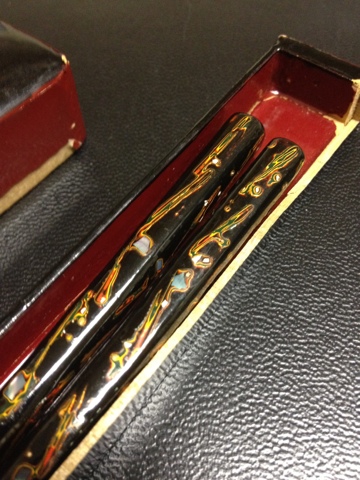
Family Treasures 2


My grandmother's chopsticks, Japan, c. 1950s?

Family Treasures

All I know about this object is that it is from South America. It seems to be ceramic, has a small hole in the top, and rattles.


Saturday, April 14, 2012

Real Live Academic Quote of the Day 4/15/12

"The two great ages of geographical discovery through the voyages of the early 1500s and through Alexander's conquests correspond to two great ages of anatomical discovery. These are also the two most inventive ages of erotic art in the West, for happy discoveries inspire a hopeful curiosity about everything."

Mayor, Artists and Anatomists, 1984

Wednesday, April 11, 2012

Bodies in the Blogosphere

I've seen most of this stuff before, but nice to have it in one place (even if not attributed):

http://marinni.livejournal.com/258692.html?thread=1060740

Tuesday, April 10, 2012

Witches Embraced in Art History

Hans Baldung Grien, New Year’s Wish with Three Witches, 1514

I first saw this image [in print] in Koerner's The Moment of Self-Portraiture of German Renaissance Art (1993). There, he used it as part of a larger argument that the self was ingrained in art, and that the viewer became the subject in that he/she had to contend with their own thoughts on the artwork at hand.

Claudia Swan used witchcraft as a way to show the imagination of, mostly, Jacques de Gheyn II in Art, Science, and Witchcraft in Early Modern Holland: Jacques de Gheyn II (1565-1629). (She also has a wonderful academic fascination with both blowfish and scientific representation).

And this filters (anachronistically) into Lyndal Roper's Oedipus and the Devil, which uses testimony of women accused of witchcraft to show, through their imaginative stories, how gender is constructed and reconstructed in a social context.

Monday, April 9, 2012

The Photographer


Edweard Muybridge is quite the character. In honor of the 182nd anniversary of his birth, Google put up a Doodle that animates his famous series of pictures proving that racing horses do, in fact, lift all their legs up at once.

This is what he's best known for -- serial photography that is now thought of as essentially the predecessor to film. But it's weird that he's still famous for his photography even though he killed another man in cold blood.

Such a story inspired Philip Glass to produce an opera called The Photographer (1982).

But what always interested me (obviously) are his body studies. He made people strip nude and move in certain ways so that he could record how the body looked in motion.

Muybridge, Woman Walking Down Stairs, 1887.

And Muybridge was also [according to some] the inspiration for one of the coolest paintings ever, Marcel Duchamp's Nude Descending Staircase, N0. 2, 1912.

Marcel Duchamp, Nude Descending Staircase, No. 2, 1912. Philadelphia Museum of Art.


Thursday, April 5, 2012

Spring is like that, I guess

Some samples of my favorite poems:

‎"Christmas lights left up all year
thus robbed of the emotive force
of their redeployment I do not like."

-Dean Young, Don't Need a New One, Just Fix What You Got


‎"April
Comes like an idiot, babbling and strewing flowers."
-Edna St Vincent Millay, Spring


Curious Fungi

Oooh, fungus book.

Tuesday, April 3, 2012

The Shitter, Exposed

"One of the pleasures of the show is being able to enjoy the details of the paintings, particularly the small figures in the background. This has been a game for centuries: in 1604 the Dutch art historian Karel van Mander recorded that Patinir was known as 'The Shitter', since his trademark was said to be the tiny figure of a defecating man, hidden in the composition. However, the exhibition suggests that this incongruous Bosch-like man appears in only three works (all once owned by Philip II)."

From Here

Also, I might add, impossibly hard to find on the interwebs.

Ephemeralia

What we know of the Renaissance are paintings and sculptures made of permanent materials--bronze and marble, mostly. But there were so many others lost to us today.

Most famously, and written of in Marina Belozerskaya's Medici Giraffe (among other places) was a snowman created from the ever-innovative hands of Michelangelo. And beyond this, there were sculptures made of ice and sugar to entertain the highest of courtly patrons.

A Short Lesson on Anatomy Lessons

Often in Dutch art, folks will see paintings titled "The Anatomy Lesson of..." Generally, these are made as portraits--and even more often guild portraits--of anatomy guilds that, like other guilds of the time, display them in their halls to celebrate their illustrious members.

One of the most famous is Rembrandt's Anatomy Lesson of Dr. Tulp:

Rembrandt van Rijn, The Anatomy Lesson of Dr. Nicholaes Tulp, 1632, Mauritshuis, The Hague

I saw this one in person and it was extremely awkard to behold, seeing as though the foreshortening and general proportions (due to faulty perspective) were off. But my hypothesis is that this is because it would have normally (in a guild hall) been displayed higher up on the wall than it was at the Mauritshuis.

What Dr. Tulp is doing is not far from what people tend to do when they get fresh crab at the beach--he is pulling on a tendon to made the hand move, just like you can with crab claws. *pinch, pinch*


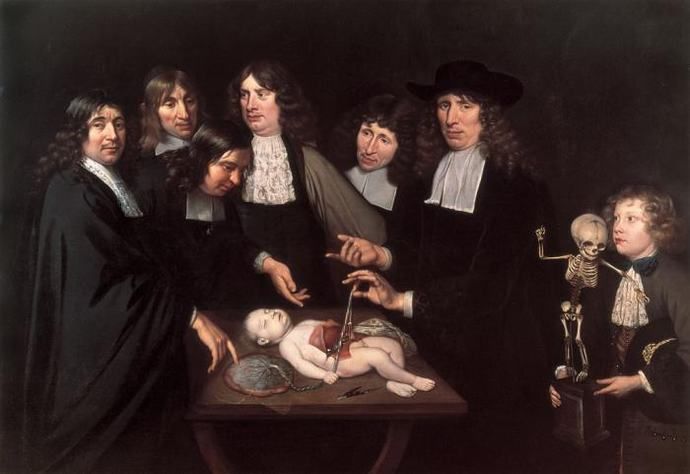
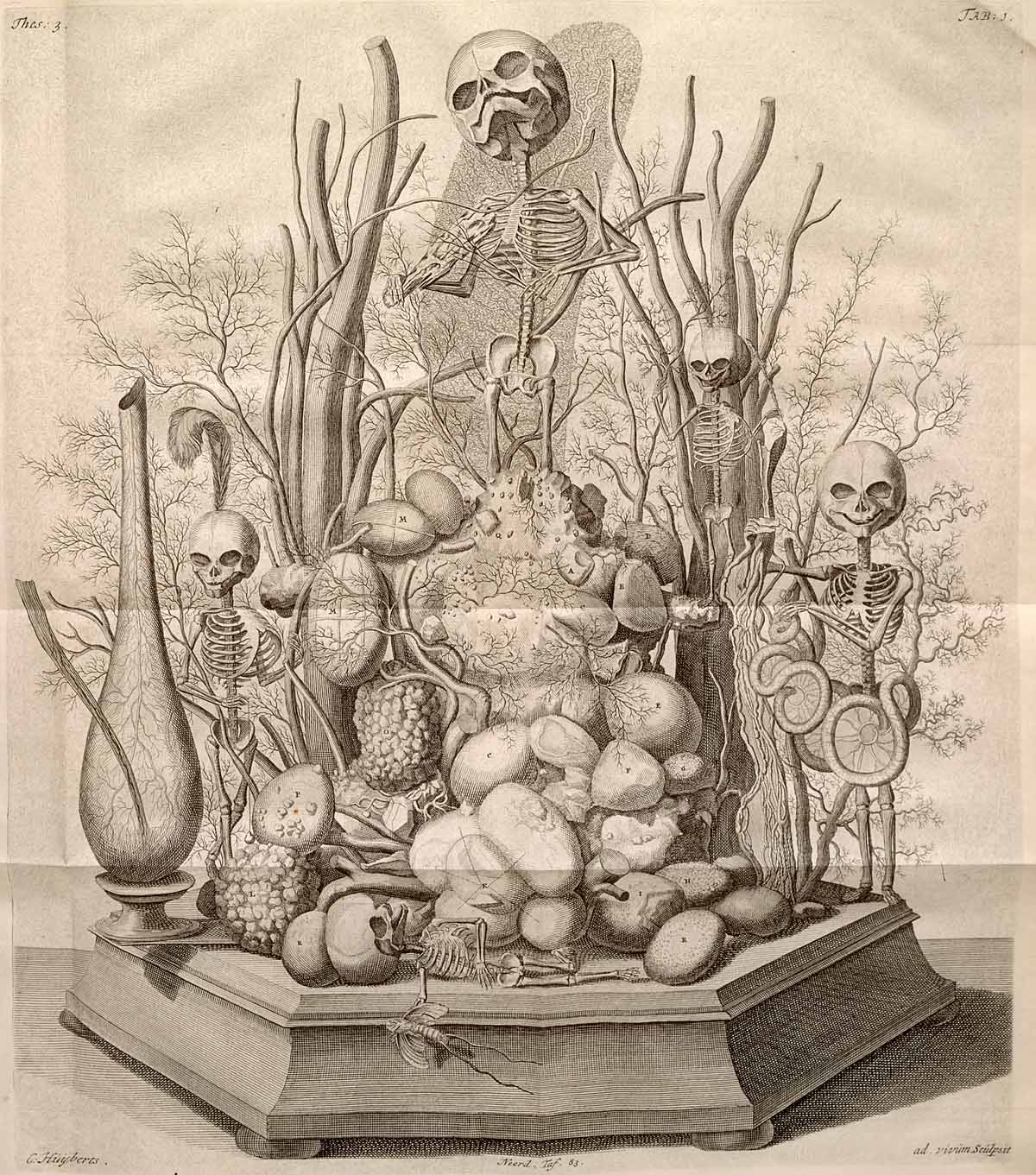
Another popular one is the AL of Dr. Ruysch, a guy best known for preserving specimens of human anatomy and creating bizarre tableaux of them, including these jolly fetuses.

Jan van Neck, The Anatomy Lesson of Dr. Frederick Ruysch, 1683, Amsterdams Historisch Museum

My latter comment might explain why his son looks scared shitless.
And, you know, all the other creepy things going on in the picture.


But my personal favorite is less known:
Michiel van Mierevelt, The Anatomy Lesson of Willem van der Meer, 1617, Stedelijk Museum Het Prinsenhof, Delft

It's my favorite because of its amazing detail. Firstly, all of the beholders are carrying little sprigs of herbs and incense to stave off the smell of the body. And the innards themselves are gleaming in an otherwordly, almost fishy manner. Well, maybe I'll just show you some of my pictures:


As Much Cooking Fun as a Bucket Full of Unicorn


Above is a hilarious and somewhat disturbing image showing the remains of a unicorn butchered for some good eatin'. Newly rediscovered at the British Library, the supposedly medieval cookbook also has instructions for feasting on non-magical animals.

(I should probably add that this was posted on April Fools Day)

Hopefully it's not a forgery, like THIS cookbook on banqueting.

Or THIS more modern forgery, on garden parties.

Seneca's Natural Questions Questioned

"Scholars have debated whether the ethical lessons derived from science are the main motivation of the Natural Questions. The debate starts from the fact that, though the work is on meteorology, the majority of books contain prefaces, conclusions, or digressions on topics that ostensibly have nothing to do with meteorology. Some of these, as just mentioned, tackle human fear of unfamiliar phenomena (6.32; 2.59). Some tackle then fashionable forms of luxurious and decadent living that abuse the gifts provided by nature: the craze for cooling drinks with snow (4b.13); the use of winds for sea-travel not to increase knowledge but to wage war (5.18); the use of mirrors by a man whose sexual antics were notorious (1.16); and the contemporary insistence on watching fish die at the dinner table before eating them (3.18)."

from Lucius Annaeus Seneca, Natural Questions, trans. Harry M. Hine (Chicago UP, 2010): 12.

Saturday, March 31, 2012

Anatomica Aesthetica

I just came across a 2010 exhibition called Anatomica Aesthetica featuring the drawings of Hamlet Frederick Aitken (1872 - 1939) and his awesome collection.

Something for the Memoirs

So circa 2010, little old me found myself hanging out with some fun ladies who were working at fashion week, then hanging out for drinks after at a swanky bar. We were all convinced to go to a members only club with another fashionister (that is the male version, right?). The whole place is black with various forms of lighting in different colors. And the only image anywhere was this:


Weird, right? But not just this. Pictured here is the first in a series of prints by William Hogarth, from 1732, called A Harlot's Progress. The series shows a woman descending into prostitution and eventually dying of venereal disease. On the wall of this club, though, was a GIANT DETAIL--blown up way beyond the original size of the engraving--of just the woman with her boob hanging out.

As a sidenote, the last in the series shows that the woman has syphilis according to the shading on her nose.


Friday, March 30, 2012

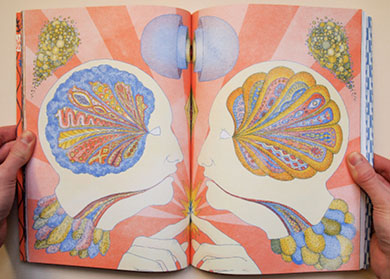
Braingasms and Hanging Hand Gardens

Weirdly unvisceral for showing viscera. Gives a whole new feel to those insides of ours:


All images from www.katie-scott.com

Wednesday, March 28, 2012

A Rare Pre-Etsy Vesalius Collage

via The Art Students League of New York

An untitled collage by feminist and erotic artist Anita Steckel, who died recently. Click here for her obituary.

Some quotes:

“If the erect penis is not wholesome enough to go into museums...it should not be considered wholesome enough to go into women.”

“Good taste is the enemy of art... It’s wonderful for curtains, but in art it’s suffocating.”

Van Gogh, Up Close-ish

Funniest thing about the exhibition Van Gogh Up Close at the PMA is that a whole section of paintings from a private collection had to have spacers to keep the audience a certain distance away.

There were also a couple of cheap side-galleries with relatively weak excuses for their existence, i.e. Van Gogh hated photography, so let's show you what he probably hated. The one on Japanese influences and Hiroshige was awesome, and also taken almost directly from the Van Gogh Museum's section on it. But it's worth seeing stuff like this:


Ando Hiroshige, Kameido Ume (Japanese apricot) Garden, 1857

See here for Van Gogh's version.

Nonetheless, lots of other good stuff going on with the paintings themselves:
Cut Sunflowers, 1887, Metropolitan Museum of Art, New York City

It's difficult to find some of the works from the show, since they didn't show many of his most famous works but had a whole slew of studies of underbrush and grasses--the grasses actually being my favorite and reminding me of Leonardo's study of hair, but with a greater sense of how he uses color and texture in light of visual movement.


Almond Blossom, 1890, Van Gogh Museum, Amsterdam

This is the final piece of the show, showing an immense sense of control--it fully displays his chosen style, but also shows an amazing amount of restraint in the coloring of the background in contrast to his much more motley scenes in the rest of the show.

Unfortunately, it is impossible to get a sense of the color of this painting without seeing it in person. Going through the gift shop afterwards made this painfully obvious. A google search is even worse: Ouch. +1 points for Wikimedia, who did the best job by far.

Oh, and just to add some Van Goghnatomy:


Tuesday, March 27, 2012

Fluxus Reliquary


Tuesday, March 20, 2012

A Pride of Peacocks


We have all, I think, been fascinated at one point or another with the naming of animal groupings, if only briefly. I like to think that there were a bunch of British men on a committee somewhere smoking pipes and pontificating on the subject, like the committee on French vocabulary. It's probably not that far from the truth.

The first relatively comprehensive list of names was from the Book of St. Albans, which was actually a sort of hunting manual/book of general zoological interest from the 15th century, and was attributed to a woman who likely just made a compendium of things invented by aristocrats of the day.

Favorites:
A SEETHING of eels.
A FLAMBOYANCE of flamingoes.
An IMPLAUSIBILITY of gnus.
A BLOAT of hippopotami.
A LOVELINESS of ladybirds.
A PARLIAMENT of owls.
A DAZZLE of zebras.